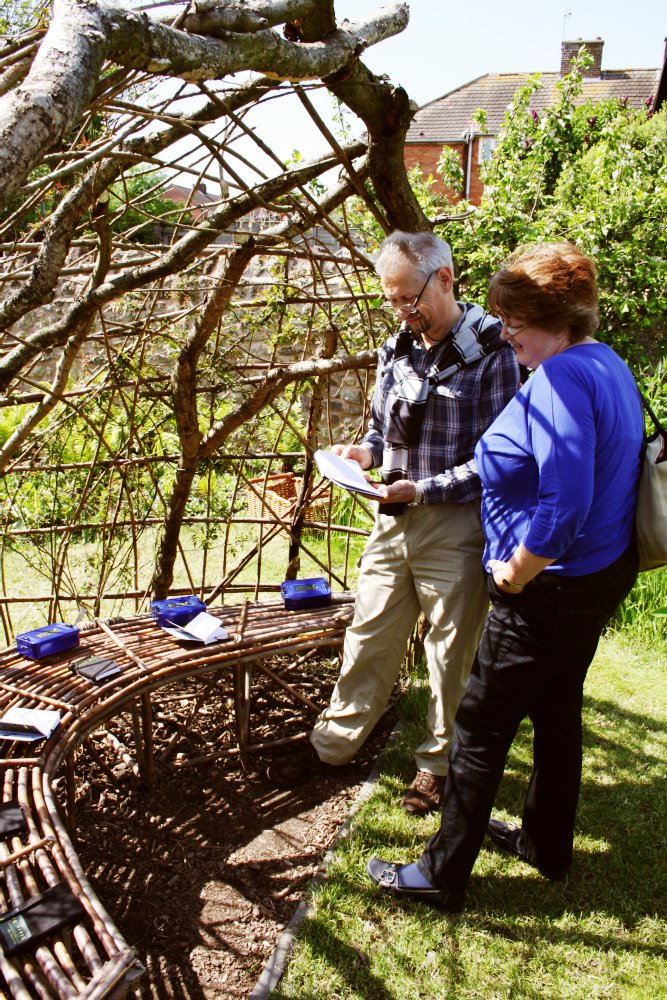
A very simple post just bringing your attention to the Exhibition at Coleridge Cottage (NT) on until Monday the 12th May from a great list of Somerset Printmakers all inspired by the Poet.
Showing posts with label coleridge cottage. Show all posts
Wednesday, 7 May 2014
Tuesday, 29 April 2014
Poetry in motion
Next month Christopher Jelley will be installing the next batch of Coleridge Way QR Code Poetry along the original 36 mile section of the trail. Last year this type of poetry was installed in several places including Nether Stowey, Webbers Post and Dunster's Conygar Tower. The codes were laser etched onto slate and installed mainly in larger tablet sized form, with the exception being Watery Lane which is at the foot of the Coleridge Way trail. Here he installed small badge sized tiles (pictured) and it was thought that works in 2014 should continue in this style as far along the trail as was feasible.
![]() |
| QR Code poem nestling on a finger post, scan if you want to read! |
Last year's poetry connected with three local schools with pupils aged between 7 and 11, and this year we have managed to up that to five schools, producing nearly 100 poems. This work (see other posts) was basically a response to the Somerset landscape, much of it along the Coleridge Way, answering the questions, what do you see, hear, feel, etc.
These poems were then whittled down to 80 or so and are at the etchers as I write, hopefully producing enough poetry tiles to cover a good section of the 36 miles of gates and sign posts from Nether Stowey to Porlock. Christopher say's 'I am really proud to be placing the words of the little authors back into the landscape which inspired them. The workshops with the schools are always full of surprises, one child wrote 'My hand is turning into a mermaids hand' magic,'
| The canopy above the Cist at Dunster Woods near Roadwater along the Coleridge Way trail. |
So how do we read the poetry?
Very simply you'll need to install an app in your smart phone, but don't worry, as there are lots of free ones available.
QR Codes are often termed square bar codes, we have been familiar with regular strip shaped bar codes for over a generation now, these are the ones on the backs of books or packs of sausages. They are just strings of numbers which the scanner reads, but with a square QR code they can include letters, numbers and other characters too.
Today you'll see them everywhere, on the backs of vans, newspaper adds or promotional links. Most often these point to web sites which the scanner then feeds you conveniently through to. But that is a level of sophistication which we don't need here, out on the Moors there is little if any reception, so linking to a website would simply not work. But if we use QR codes in their simplest form, to reveal plain text, then we can encode short stanza's of poetry inside. Your smart phone decodes through its lens and you can read the hidden words without internet reception, it's all done in the handset.
![]() |
| The Cist clearing at Dunster Woods near Roadwater along the Coleridge Way trail. |
So before you embark (and leave wifi and data zones behind) install a scanning app in your smart phone, there are lots to choose from as QR codes have been around for about 20 years. Choose a free one which will do everything you will need and possibly a lot more. Install it and give it a go scanning anything that you see, my photograph of the finger post above works, and newspapers are often full of them.
So here are two examples of the pupils poetry, both were written by Stogursey Primary school children, they are inspired by their walk at Hodders Combe which was a favourite haunt of Coleridge and the Wordsworths.
1
as I walked through the
lush green Hodders Combe
I heard the birds tweeting
morning greetings
as I wondered through the
sunny Hodders Combe
I saw a fence protecting
people from fallen trees
in the morning breeze
the beautiful sun was
beaming like a star
as I walked through the
calm Hodders Combe
I got to the enchanted
river
I saw the freezing cold
water fighting it's way
over the gleaming fallen
tree log
2
it was a lovely summers
day
birds were singing happily
a chainsaw was stretching
like an animal
birds were whisking
I saw an extremely fluffy
sheep
and webs that looked like
stars
I smelt the minty moss
and elf ears in the trees
there were pretty leaves
everywhere
then I got pricked
Wednesday, 31 July 2013
. . relish the rain and sun in equal measure
In a shady valley not far from here, where the river slides over cool rocks beneath muscular Oaks, the Last Queen visited once. A small courtage followed and everyone barefoot (by decree) till the edge of Paisey Pool. There she stepped lightly into the cool waters and even the birds were hush as she dipped beneath the water, her train billowing in the flow. But when she emerged but a heart beat later age had been purged from her limbs and her body was lithe and supple.
She turned to the company and addressed the barefoot lords who waited.
'These are the new rules of my reign' and the scribe began to take notes.
'Firstly . . .
We shall walk barefoot always, mirrors will be banished - our lovers, children and friends will reflect our beauty in all our transformations.
We will dine on nothing but the finest, freshest fruits and berries.
Celebrate each season, relish the rain and sun in equal measure.
Have no need for clocks or time pieces other than the sun and the moon.
We shall . .
![]() |
| Fragment from story book box at Webbers Post |
![]() |
| Continuation of the story above. |
Yesterday I ventured out to the Jubilee Hut at Webbers Post with a little intrepidation, the last time I visited I removed a book which was full and replaced it with this one. It was only about two weeks ago, but the journal in question had become a visitor book, not a story book.
The concept of the story box is simple, find the box read the tale so far, add a drawing or paragraph but no more then leave for the next walker. So when it devolves into a guest book I feel a little saddened and hoped this one would not fall foul the same. I wrestled with putting a note inside saying 'This is not a visitor book, story only please' but I rile at that, my mind set is one of enablement, not of impediments. But once someone breaks the thread of a tale it drifts naturally into the visitor book mode. So with all that said, just before I set out I did print some thin book marks to tuck in the active pages to negate the drift.
Also last week I received an email from Katie Bourne who stumbled across this story box with her two year old and loved the project, she also mentioned 'the visitor book syndrome' and I knew she was looking at the newly installed journal which added to my anxiety. She went on to link to a Braunton project which she had managed a while back, similar to my storywalks work with GPS location triggered content, but Katie admits herself that some of the tech is already a little dated, but still worth checking out.
So yesterday I walked through the sun dappled trees at Webbers Post on the way to the Jubilee Hut which is where this box is installed. It is a stunning location, the crunch of pine needles, glimpses of deer (got close enough to pet two!) give me any excuse to go breath in the Exmoor tonic.
![]() |
| Illustration of Dunkery Beacon from this story box location |
So I nervously approached the box, pleased it had not disappeared totally, (I am expecting to lose one or two over the summer). But the box looked perfect, with a good scuff on the lid (good, box in use), I opened it and found it well used in a relatively short period, but more to the point it was well used in the intended manner. Yes there are a few additions which wander off into the guest book cul-de-sac, but the meat is of tale, and more than I could have hoped.
![]() |
| Story Box on the bench next to the QR poetry project at the Jubilee Hut, Webbers Post. |
I added a little tale to the tale to gather some of the threads, took lots of pictures of the pages and then left the box once again to the wilds and whims of strangers. But when I checked my photo's at home last night, they were dreadful, so later that evening I drove out again with Davina (Walking Book Club), and not only did we see more deer, but a stunning sunset, and in that short time another visitor had added to the tale.
Brilliant.
So thanks to all those who have contributed, for me it recharges my faith in the creativity of strangers, the willingness to engage with the wilds of Exmoor, and add a little cumulative magic to the whole, just for the fun of it.
I know that in years to come I will meet people who will remember stumbling across the story boxes, anonymously adding their mark or just enjoy seeing the of story grow there in.
Monday, 22 July 2013
The Story Box Story, or the tale and trail so far.
Nether Stowey, Watery Lane, the first proper stretch of the Coleridge Way, where you leave the tarmac and traffic behind, this is the first act in a 36 mile play of ruts and rises, tunnels and vistas, heath and heather, cutting and combe. What has struck me, having been along pieces of the Coleridge Way regularly over the past few months is how the mood changes and transforms. Whether it's a quick dash in a cool evening to the story boxes, or more of a walk and rest with pencil and patience, the atmosphere is dynamic, never the same, always transforming, evolving, which I suppose this is what a living thing does.
But more recently my main focus has been the Story Boxes which I placed along the trail early June time. So how have they been fairing? and if you are unaware of this project have a look at this link with a map and descriptions of locations.
Well judging by these images I think rather better than expected, there have been drawings, poems, and little ditties, with a very small amount of abuse (I only left pencils in the boxes) The Coleridge Cottage booklet has developed well, though the paints I left inside were useless, and they have just installed an interpretation post in the arbour itself. Which is brilliant but when you need to focus on writing, it's not easy doing so with Coleridge's 'Lime Tree Bower' weaving it's magic across you.
Horner Garden Tea Rooms has a relatively small amount of work in, though we are just on the cusp of holiday season, so that should pick up soon. But even with only a little inside, it has the most beautiful drawing of a campsite in a valley.
The Jubilee Hut, which has Taffy Thomas' story at the beginning, has funnily fared the poorest in my opinion, which is somewhat disappointing. It just devolved into a visitors book, with most inputs by Duke of Edinburgh Awards kids hiking through. The book in question has been visited a lot, as it's now full, but the majority of inputs have no story, or only tiny fragments of a tale which bare no connection to the task set. I have a mind to write a big note - This is not a visitor book - please write story or draw. I'll see how we go now that the D of E are out of the way, but they are by no means the only culprits, but did set the trend.
So dear reader my challenge is out to you, to gather your tales and head out to the boxes, restrict yourself to just the task in hand of adding a little to the story so far, doing a drawing but no more and then leaving the story box for the next to find and do the same. This blog I will keep short as I think the pictures speak the loudest, and at the end of the summer (September) the books are to be exhibited at Venue 23 in Dulverton for Somerset Art Week, and also Porlock Festival. So you still have plenty of time to hunt out the story boxes and add your little magic, I recommend you do as I have, and return again and again for this is how the Coleridge Way is rejuvenated.
Labels:
coleridge,
coleridge cottage,
Coleridge Way,
Horner Graden Tea Rooms,
story boxes,
webbers post
Location:
Somerset, UK
Wednesday, 3 July 2013
Watchet Sounds
![]() |
| Testing the sound pools along Watchet Easy Quay |
Ralph Hoyte and his team, came down to Watchet on Sunday to road test their new app, iron out glitches, and get some user group feedback. I had my eye's peeled for their approach as I was working on the Contains Art project (Three shipping containers being converted into Artist's studios and exhibition space, these are due to open on Saturday 6th July! eek)
I was busily fitting timber around the exhibition container door when I spied two lone figures glide into the yard, immersed in some other world, I knew instinctively that Ralph must be about.
![]() |
![]() |
| Rachel Hill from Halsway Manor listening in to a GPS triggered dialogue between Coleridge and Dorothy Wordsworth |
The concept is simple enough, all you nee to do is walk around Watchet with his app installed in your smart phone, and in specific places Ralph has mapped 'sound pools'.
But what is a sound pool?
Smart phones know where you are as they have a Satellite (GPS) chip inside and with this location data it is possible (by those who know how!) to programme your device to deliver audio at a given location. In Watchet Ralph has set out seven sound pools, one on each pier end, with another five strung between.
The audio which triggers are no groovey tunes but highly orchestrated dialogues between William, Dorothy (Wordsworth) and Samuel Taylor Coleridge. Some of the audio files are the poems, Kubla Khan, Ryme of the Ancient Mariner, but the majority are sophisticated dialogues between the three. They are fiction, but fiction based on solid facts, which Ralph has gone to exorbitant lengths to make as authentic as possible, and what a result.
The final pieces (of which I got a sneaky peak of just three) are stunning, in a medium which can easily show incompetence since we are so accustomed to high production quality these days.
On the day there were technical difficulties which Ralph and his team were scratching their heads about, and perhaps the very essence of field tests and user group feed back. Scratch building apps to run code is like entering another realm, but if this taste is anything to go by, then it is defiantly worth the hard work and for us the wait.
The final work is due to be available to the public in September with multiple sound pools all over 'Coleridge Country'. There is a link on the right for Ralph's blog which is perhaps the best place to touch base right now, but soon the app will be available for both Android and Apple device's, and then you will catch glimpses of people, lost to the audio of another time and rooted to the very places it all happened, some 200 years ago.
Tuesday, 18 June 2013
Story boxes, films and the Coleridge Way
All the story boxes are out in the field now and I wanted to create a film which evoked the mood of reading and writing, of discovering and then entering into a tale. The opening shots are filmed at Coleridge Cottage Nether Stowey, the weather was glorious and I had the garden to myself. So I set out all the boxes in the Arbor and started some filming, but no sooner did I have the camera out than I had people looking and opening the boxes (which is what they are about).
![]() |
| Ken Luxon Story Teller reading Taffy Thomas' Tale |
A few conversations later, and I picked up the camera again, just to put it back down and to talk some more about the authors. One couple who had enjoyed the house and ready to move on asked me briefly about the boxes.
'They are story boxes' I proudly said.
'Oh she replied, my husband Ken is a story teller.'
Well perhaps before you leave you might like to read this one which is started by Taffy Thomas?'
'What, thee Taffy Thomas?' they said in unison.
'Yes, Mr Story Teller Laureate himself.'
'Oh well I can't leave without reading Taffy's tale.' (Pictured Ken Luxon and his Wife)
The other major author is Jackie Morris, and her tale is magical, which also includes an illustration of a fox. (I have included paints in some of the boxes but not this one as I want it to stay really nice!) It was last seen at Coleridge Cottage in the clutches of a woman who was so attached she couldn't put it down to let the next walker write their piece, (she might still be there!)
Caroline Taylor (Assistant house manager of Coleridge Cottage NT) has started another, and of course I have done one too. The words in the film are mine and from the 'Watery Lane' story box, this place seemed just right for a Goblin Market style poem, or at least the start of one.
So now they are out, all in the wild, with tales to be guided and penned by wandering souls, some will stumble upon them, others hunted out. Some will be visited again and again, others more sparingly, but in September they are to be exhibited firstly at Porlock Arts Festival then in Dulverton for Christopher Jelley's Somerset Art Week, and finally at Coleridge Cottage itself in the garden room if all goes to plan.
So hunt them out, read, write, enjoy and let me know how you get on, and if you twitter use #storywalks, and here is a map to story box locations so you can plan your trip.
Subscribe to:
Posts (Atom)